People fly twelve hours for Atacama's landscapes and then, quietly, the sky becomes the main event. This guide covers when to come, how the moon decides everything, what a US$30 tour actually includes, and whether you can do it yourself — plus the cold-weather kit that night one always proves you needed.
Why the Atacama sky is the best on Earth
Three ingredients, all present. First, dryness: parts of the Atacama go years without meaningful rainfall, and water vapor is what makes stars twinkle and blur. Second, darkness: San Pedro is a town of about 2,500 people with no city glow, and the nearest real city is over the Andes. Third, altitude and latitude: 2,450 m puts you above a chunk of the atmosphere, at a latitude where the Milky Way core passes nearly overhead. Europe's best dark-sky parks never combine all three — it is why ALMA and Paranal were built here.
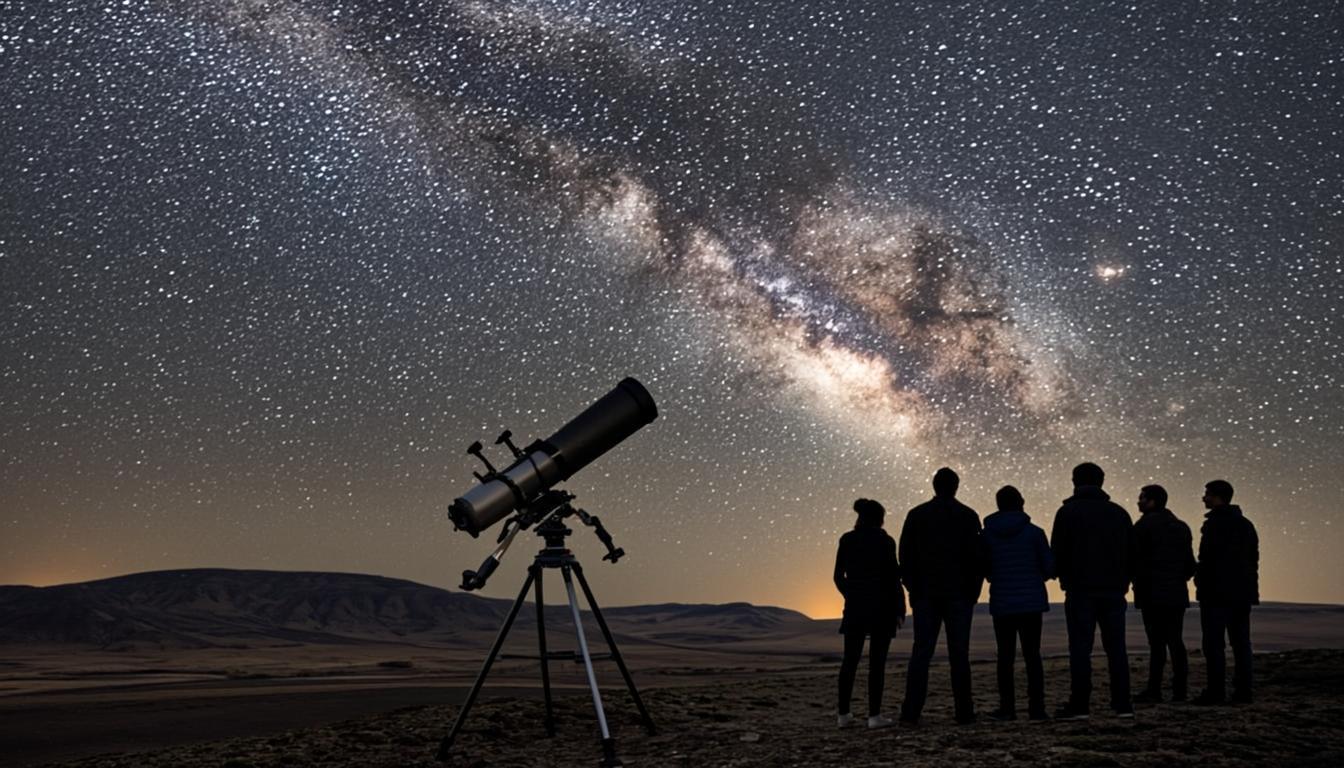
For the visitor it means something simple: on a moonless night you can see the Milky Way with the naked eye, watch dark adaptation build over fifteen minutes, and — through a decent telescope — pick out Saturn's rings, nebulae and globular clusters that most of the world never sees from a city. If the sky is the main event for you, give it two or three nights: that is what the extra day buys.
Milky Way season and the new-moon rule
Stargazing is possible year-round; the Milky Way's bright core is visible from roughly April to October, arcing highest around midnight in May, June and July. The moon is the real constraint: within about three nights of full moon, moonlight washes out the faint structure entirely. Serious stargazers plan trips around the new moon — the single most important date in Atacama astronomy.
New moon ±3 nights: darkest skies, Milky Way core at its best — book one to two months ahead.
First and last quarter: still good; planets and star clusters shine regardless.
Full moon ±3 nights: landscape glows silver and faint objects wash out — better for photographing terrain than sky.
One rule beats every other tip in this guide: check the moon phase before you book flights — it matters more than the month you choose.
Moon phases: the exact planning rule
The moon runs Atacama astronomy on a 29.5-day cycle, and the gap between a new-moon night and a full-moon night is the gap between the best sky of your life and a washed-out gray. The working rule, with exact windows — "±2 nights" means two nights either side of the phase:
Practical corollary: in May, June and July the new moon lands while the Milky Way core is already high by midnight — the triple jackpot, which is why new-moon slots in those weeks sell out two to four weeks ahead. Book the tour before the flight, and check exact dates with the moon tool.
Fix your dates around the new moon ±2 nights first and everything else second — it outweighs month, weather odds and tour choice.
What a stargazing tour includes
The standard tour (US$30–35, about 2.5–3 hours) is a small-group van to a dark site 15–40 minutes from town, an astronomer or trained guide, and a battery of 8–14 inch telescopes on tracking mounts. Expect a naked-eye constellation orientation, five to eight telescope targets (Saturn, Jupiter seasonally, clusters, nebulae), hot drinks and usually a photo: guides shoot the Milky Way over the group with your phone or camera. Hotel pickup is included, and the dress code is winter regardless of season — the packing list covers the night kit.
The astronomical-tour tier (from US$33 in our catalog) adds deeper telescope time and smaller groups — worth it if you already know your way around a sky map. What no tour can promise is cloud cover: operators usually reschedule or refund if the sky fails, so book your first or second night and keep room for a retry. Browse the catalog and compare group sizes before committing.
DIY stargazing vs a tour
You can absolutely see the Atacama sky yourself: walk ten to fifteen minutes from the center, kill your lights and look up. What you give up is interpretation and aperture. Without a guide, most visitors find Orion and the Southern Cross and little else; without a 12-inch telescope, Saturn stays a bright dot instead of a ring system. Tours also solve the two real DIY problems — cold (a parked car is not a warm room after midnight) and unlit desert roads.
The hybrid we recommend: one guided tour for the telescope night, one free night simply lying back from a hotel rooftop or a sun lounger. The sky repeats itself; your neck and your schedule both benefit. And in shoulder season, tours are quieter and the guides have more time per person.
Observatories: what is actually possible
The giant observatories are research facilities, not attractions. ALMA runs free guided visits on specific weekends only, with reservations that open months ahead — a lottery, not a plan. Paranal, home of the VLT, suspended routine public visits years ago. What works for travelers: the public programs around San Pedro, where several local observatories open nightly with medium-aperture telescopes, plus the tours above — which for most people beat a distant dome visit anyway. Do not plan a trip around ALMA; plan it around the new moon.
Book any observatory-style program for a bright-moon night and save the dark-sky tour for the moonless ones — that is the allocation working photographers use. And temper expectations about photography: modern phones capture the Milky Way in night mode, but a small tripod still transforms the shot.
Astrophotography on a phone: settings that actually work
You do not need a camera to bring the Milky Way home anymore — phones from roughly 2020 onward capture it from a sky this dark in night mode. Everything below is really about one thing: staying still. Motion, not darkness, is what ruins the shot.
Night mode, 3–10 second exposure: start at 5s. Stars trailing? Go shorter. Noisy? Brace better rather than going longer.
Something solid under the phone: mini tripod, jacket-wrapped rock, car roof — or ask the guide; most tours carry spare tripods and will set you up.
The 2-second self-timer (or a volume-button trigger): pressing the shutter shakes the phone for the first second even on a tripod.
Manual focus to infinity if your camera app allows it (third-party apps unlock it on most phones); otherwise tap the brightest star and lock focus.
The main wide lens, not ultrawide or zoom: the main sensor gathers the light; the others crop it.
Screen brightness down, red-light mode on if the phone has it — one white flash resets the whole group's night vision.
Shoot the staged frame: guides laser-point a silhouette composition against the core at the end — that is the photo you post.
One habit does all the work: stay still longer than feels reasonable — five seconds of perfect stillness beats twenty of clever settings.
Dressing for a 0°C night (yes, even in summer)
The desert dumps its heat the moment the sun sets. Summer stargazing nights run 5–10°C; winter ones drop below freezing, and standing still for three hours makes it feel worse than the number suggests. The kit: a fleece plus windproof shell, beanie, gloves, closed shoes and thick socks. A thermos of coca or mate tea is a marker of any operator worth booking.
Fleece or wool mid-layer plus a windproof outer — the wind is what gets you
Beanie and gloves: non-negotiable from April to October
Closed shoes and warm socks; leave the sandals at the hotel
A red-light headlamp if you have one — white light resets everyone's night vision
Skip alcohol before the tour: it dilates vessels and makes you measurably colder
Give your eyes twenty minutes. Every guide says it and almost nobody does it: skip the phone screen, and the Milky Way that fades in at minute twenty is the reason you came.
Frequently asked questions
Sources & verification
Every fact in this guide was checked against Chilean institutions and reference services. We list the sources so you can verify the basics yourself — and because we do not accept sponsored claims from tour operators.
- ESO — dark-sky protection and world-class astronomy in northern Chile
- MeteoChile — cloud-cover and climate records behind the Atacama clear-sky statistics
- MoonCalc — moon phase, moonrise and moonset times used to plan new-moon sessions
- timeanddate — sunset and true-darkness times for timing each stargazing night
External links open in a new tab and lead to official Spanish-language pages. Park rules and fees can change seasonally — double-check before you travel.